
Event Operations
Best Practices For Drive-In Events
Practical considerations for producing drive-in events during the COVID-19 pandemic.
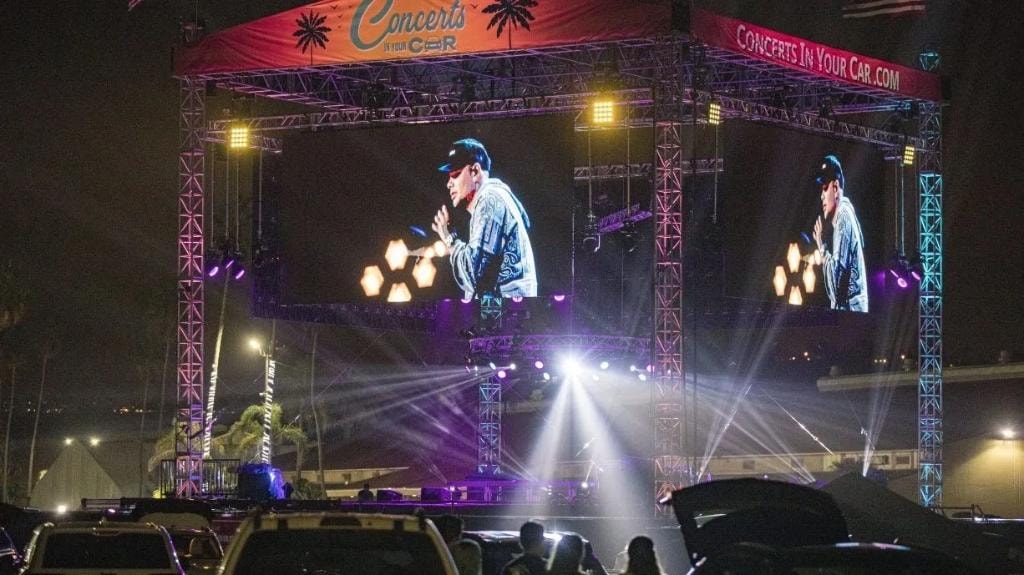
Kane Brown preforming for Encore Drive-In Nights, simulcasted across hundreds of venues across the US.
A few weeks ago, I posted some pictures on LinkedIn of my experiences concerning “the new normal” in live entertainment, drive-in shows. Q3 of 2020 saw a proliferation of drive-in shows across the US for live and simulcasted concerts, stand-up comedy, theater and even the opera . The trend is continuing in Q4 in those areas with mild winter climates (e.g. Los Angeles, where I live). In the last three-plus months, I have been involved in several different facets of drive-in performances, the ticketing management side, the promoter side, the event management side, and as a patron. I thought I’d share some of my thoughts and best practices for everyone.
Well… before we get into best practices, first and foremost make sure you are aware of all state and local ordinances governing your event. Do patrons/employees/performers need to wear face coverings? Are there special sanitization or patron screening requirements? Do you need the contact information of everyone coming to the show? Are special permits needed to host the event? The US Federal government has taken a very decentralized approach to handling the COVID pandemic. As such, many states have different laws from each other. Here in California, it’s even more fragmented because each county board of health has its own set of rules, so a neighboring municipality may be operating under a different set of laws than yours. I know it can be frustrating that some parts of the country seem to be back to almost-normal, but unintentionally (or deliberately) flouting the law is at best bad optics, and at worst a public health crisis. I’m sure we all have strong opinions about how politicians and governments have managed this pandemic with regards to the live entertainment industry but going rogue is not going to help our cause. Also, I acknowledge that there may be certain requirements set forth by governmental agencies that will counter some of the best practices I outline below.
Now we got that out of the way, here we go:
1. Be upfront about your ticket pricing – is it per vehicle or per person? I recommend selling tickets per vehicle , but you need to make that fact unbelievably obvious and apparent to avoid “sticker shock”.
2. If you are selling tickets on a per vehicle basis, don’t set an arbitrary limit of people per vehicle. Some minivans or SUV’s can seat eight people, so a four-person limit doesn’t really work. Plus, we should be trying to be as accommodating as possible during this time.
3. Avoid using hard tickets, will call or having in-person cash sales. Not only are these things frowned upon during the pandemic, but the drive-in setting is less secure, and it is more cumbersome to manage typical box office functions. Mobile-enabled tickets are the best way to go.
4. Review your parking and ingress procedures. You need to think like a parking lot operator and not a live entertainment venue operator. It is a lot faster to move individual people through turnstiles than vehicles through a crowded parking lot. I have found that one ticket taker can only scan at best, about 75-85 tickets (vehicles) per hour. If you have an event that has 500 tickets (vehicles) with gates opening one hour prior to show, I recommend at least eight ticket takers. Depending on whether or not there is excess real estate in the parking lot to queue vehicles prior to the gates opening, I would also set an arrival time cutoff to avoid idling vehicles backing up on to the street as they wait to enter.
5. If possible, space out the vehicles in the parking lot to allow patrons to sit outside.
6. Sell concessions, including alcohol, during the event. I understand the need to limit the amount of people in line, but there are applications like FanFood and Seatserve to facilitate cashless and contactless sales. If concession sales are not an option, then allow patrons to bring their own into the drive-in.
7. Make sure bathrooms are available. This seems obvious, but I was at a drive event a few days ago where bathrooms were not available unless it was “an emergency”. If you are going to host an event, don’t discourage bathroom usage. I mean, we all need to pee and poop, right? Porta-potties are a good work-around for large, isolated parking lots and they also provide for social distancing. However, using one at night is not always the best experience and they can be cost-prohibitive if you’re only renting them for a day or two. The best bet is to allow access inside a venue to use permanent bathrooms. It may be necessary to staff an attendant at each bathroom to enforce capacity and social distancing. It’s also a good idea to block off every other bathroom sink and men’s room urinals.
8. Consider audience feedback, especially if you’re doing a stand-up comedy drive-in event. Applause will not be very loud, especially if everyone must sit inside their vehicle. Honking car horns do not make the best noisemakers. People are at an event, not driving down Wilshire Blvd. Perhaps the front row of cars can be mic’d up? Noisemakers like handclappers or thunder sticks are good as well. Plus, these items can be easily included as part of a sponsorship activation.
9. The production will need to be more robust than if you were at a normal venue. Remember, you’re not inside. Projection or LED screens may be needed, depending on the size of the parking lot. A FM radio transmitter and/or a streaming app is a nice supplement, but nothing can replace a traditional PA set up. Again, depending on the size of the parking lot, sound delay towers may be needed. Truss, rigging and staging is also critical. If your drive-in is not adjacent to a venue, you also need to consider things like artist dressing rooms, green room, crew catering areas and production offices.
10. It is important to communicate up front with all ticket buyers and other stakeholders to manage everyone’s expectations on the day-of-show. (Don’t wait until you send a “know before you go” email because, let’s face it, not as many people read those as we all would like.) Inevitably, many ticket buyers have never attended a drive-in event before. Be sure to include all pertinent information as discussed above. It is also good to give each vehicle a handout as they are scanned in that includes all the event policies.
Drive-in events are not going to be hugely profitable endeavors. They are going to cost more to produce, and cost more to staff, on a per capita basis than an event in a “regular” live entertainment venue. They are hard to scale up to anything more than a 1,000-1,500-person capacity theater show, so artist guarantees will need to be in line with that. Breaking even, or just losing less money than by doing nothing, are reasonable financial benchmarks. There also needs to be careful consideration about the patron experience since drive-in shows are still a new concept. A drive-in event run on a shoestring budget will seem like a cheaply produced, high school drama club production that may alienate fans of the artist or venue from attending future performances.
I believe the goal during the current pandemic should be to provide a respite for people during this chaotic period while also affording an industry that has been decimated by government shutdowns limited opportunities to actually do its job. That said, it will be interesting to see if drive-in events remain part of the live event repertoire once COVID restrictions begin to ease everywhere across the country.
What do you guys think about drive-in shows? Did I miss something in my article? Please share your thoughts in the comments.