
Ticketing Industry
Masters Ticket Meltdown
The 2025 Masters Tournament at Augusta National Golf Club in Augusta, Georgia, was marred by significant ticketing issues that disrupted the experience for many patrons.
The 2025 Masters Tournament at Augusta National Golf Club in Augusta, Georgia, was marred by significant ticketing issues that disrupted the experience for many patrons.
Background
The Masters is one of the four “major” professional golf tournaments held each year and is arguably one of the most prestigious sporting events in the world. Augusta National Golf Club (AGNC) is both the venue and the operator of the tournament. As such, ANGC sets and enforces all policies and procedures with regards to the Masters. AGNC bills The Masters as “ a tradition unlike any other ”. Well, that tradition was put to the test this past week at the 2025 tournament, specifically as it relates to ticketing.
AGNC does not run their ticket operations like the vast majority of events, especially large-scale ones such as The Masters. Tickets never “go onsale” like they would for a typical event. Instead there is a lottery system for ticket distribution, with applications accepted in June and notifications in July. For 2025, the lottery window was June 1-20, 2024, with winners notified by July's end (Masters Ticket Application Process). Tickets cost $100 for practice rounds and $140 for tournament days, but demand was high, with less than 1% of applicants winning, thus creating significant access barriers. AGNC members and patrons lucky enough to be added to the ticket distribution list before it closed to the public decades ago had access to purchase four-day tickets for $450.
In short, Masters tickets are a closed (primary) market. AGNC has a policy against reselling Masters tickets and has selectively enforced it in the past. That said, ticket resale has been happening for decades; an “open secret” if you will. An entire ecosystem of third-party hospitality providers pops up every year across the street from AGNC during Masters week. The is also plenty of ticket brokering as one might expect for a highly desirable event such as the Masters that has gone on relatively unabated through the years. AGNC historically has avoided any kind of official ticketing consolidation, distribution, or hospitality partnerships. They don’t even use a traditional ticket system, opting for their own proprietary system instead.
An added layer to the ticketing process is that there are no actual tickets issued. The “tickets” are badges, similar to what media and staff wear at other events, but uncommon for spectators to be given. These badges are equipped with an RFID chip that pings when passed through a reader, like how an EZ-Pass or FasTrak works in your car as you enter a toll road/lane. AGNC also has a no cell phone policy on the grounds, making digital tickets nearly impossible to utilize without also using a magnetic phone pouch service, which can create its own operational challenges.
What Happened
Beginning the week prior to The Masters, individual day tickets were in the $2,000 - $3,000 range which is “normal”. However, over that weekend into early part of the week of The Masters, the secondary ticket market began to get surprisingly tight. Practice round tickets were $4,000 and four-day badges were going for $25,000 by Monday of Masters Week.
Apparently, AGNC cancelled a lot of ticket orders in the weeks and even days leading up to the Masters, effectively crashing the secondary (resale) ticket market. This unexpected rug-pull led to a short-squeeze for brokers who had yet to acquire tickets to close out their positions, which meant that they had to take a huge loss or fill the order or bust it entirely. A “busted” ticket order means the broker tells their buyer, “sorry, I can’t get you tickets after all” and refunds their money, leaving people who thought they had tickets scrambling at the last minute. An event like The Masters draws people in from all over the world and many folks had already traveled to Augusta when they found out they were out of luck.
The resale marketplaces (StubHub, Vivid Seats SeatGeek, etc.) also removed any Masters listings by the weekend, not that they really had much inventory anyway. What little inventory they did have was listed at ridiculous prices. This crackdown also led to bizarre situations such as someone who won the ticket lottery having their tickets cancelled because they were doxxed online and AGNC refused to do anything about it, four-day badges scanning on some days, but not others, and reportedly up to 3,000 badge holders were “interrogated” at the gates.
While it’s understandable that many people really don’t feel sorry for ticket brokers, who at best operate in a “gray area” and at worst are criminals, getting screwed over, there were thousands of golf fans who got shut out at The Masters this year. Now, there are plenty of Internet scolds and golf stans that will say things like, “they should have known there is no resale”, “it’s Augusta, they can do what they want”, they average person looking to put together a trip of a lifetime and Googling where they can get tickets or hospitality packages probably isn’t aware of this, even if it is technically correct.
It’s also a fact that event organizers have every right to institute ticket policies as they see fit. After all, tickets are simply licenses that grant a person admission to a specific place at a specific time. However, just because ANGC CAN do something like a last-minute ticket purge, doesn’t necessarily mean they SHOULD.
Why Did This Happen
Just like any other nightmare ticketing scenario, there isn’t one thing to blame. First of all, The Masters is incredible popular. It’s pop culture, it’s a de facto championship event, it’s historic and it has an amazing brand. (Did you hear about Your mom, who could care less about golf, has heard of The Masters. This means a healthy demand for tickets is assured every year.
Second, ticket brokers shorting the market. Typically, these are the folks who deserve most of the blame for a situation like this, however it’s fair in this case to reserve SOME judgement because AGNC put their thumb on the scale. Regardless, if you don’t have the financial resources to cover your liabilities, don’t short the ticket market. Perhaps it’s time to require ticket brokers to be bonded?
Lastly, AGNC deserves the lion’s share of the blame here. This was a situation that never needed to happen. For years, they ticketed the Masters like it was still 1977 and buried their head in the sand (trap) while third-parties capitalized on the interest of the event both for straight up ticket sales and corporate hospitality. One of these third-parties is now known as On Location, formerly know as Prime Sport. On Location is a packager of VIP experiences and has an amazing portfolio of clients including The NFL, WWE, NCAA, The Tournament of Roses among others. Over the course of many years, On Location has become one of the largest resellers of badges to The Masters, though in an unofficial capacity
Over the last few years, AGNC has spent ~$200M on property acquisitions around the golf course. As such, they have been looking for ways to increase revenue, while maintaining their public stance on not chasing every single dollar. (See their concession prices or TV deal with CBS.) .
Enter On Location. Beginning in 2024, a new hospitality area called Map & Flag (named after The Masters logo) popped up across the street. This hospitality area is reportedly run by On Location and it is rumored that AGNC is going to announce an official partnership with AGNC for the 2026 tournament. In exchange for the official partner status, On Location allegedly gave up its Masters ticket customer list to AGNC, which then used that information to try and reclaim as many tickets as possible. Those tickets will then presumably be packaged by On Location next year to be part of official experiences that sell for five and six figures, with a good chunk of the revenue flowing back to AGNC.
With all of this information in mind, it’s reasonable to assume that the secondary market ticket collapse was a calculated and deliberate act by AGNC. Wanting to secure an official hospitality partner is by no means nefarious, but they simply could have identified the tickets they wished to reclaim, without turning away thousands of ticket holders who likely had no idea what was going on and were stuck spending money on a trip to Augusta, GA for no reason. Then this summer, they could have made their move to reclaim the tickets for On Location.
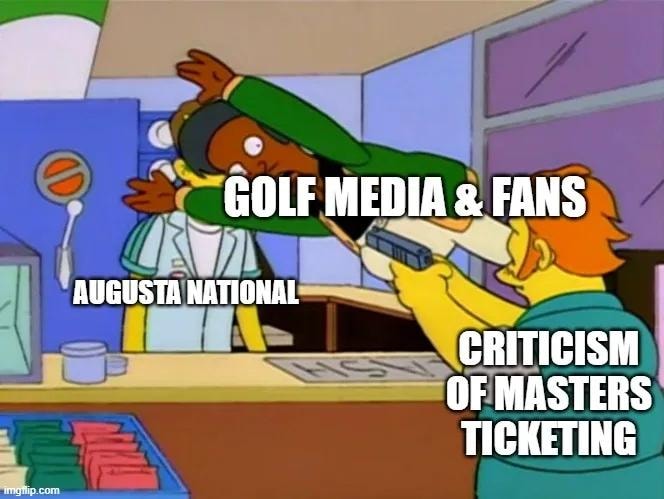
Whether or not they chose to respond officially to this situation (they won’t), or if the national golf media decides to cover this story in earnest (they definitely won’t), the AGNC brand was damaged this past weekend. Will this stop people from trying to get tickets to next year’s Master Tournament? (It won’t.)